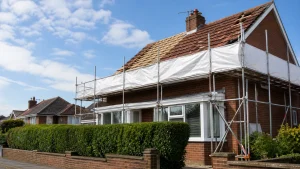
A leak is never welcome, but not every roof problem behaves in the same way. A flat roof and a pitched tiled or slate roof shed water differently, use different materials and often show damage in different places.
For homeowners, understanding those differences can make conversations with a roofer much clearer. It also helps explain why the right repair approach matters, especially when a small issue could be hiding a wider problem beneath the surface.
Flat roofs and tiled roofs manage water differently

The biggest practical difference is how each roof moves rainwater away from the building. A pitched tiled or slate roof uses its angle, overlap and rows of individual tiles or slates to direct water down into the guttering. If one tile slips, cracks or lifts, the surrounding roof may still continue to shed most of the water, although the exposed area can quickly become vulnerable.
A flat roof is not usually completely flat, but it has a much shallower fall. Water needs to move across a continuous waterproof surface towards outlets, trims or guttering. Because the surface is designed as one connected layer, damage in one area can affect how the whole roof performs. Ponding water, splits, blisters, lifted edges and failed joints can all interfere with that waterproof layer.
This means flat roof repairs often focus on the condition of the membrane, the edges and the drainage points. Tiled and slate roof repairs are more likely to focus on individual coverings, battens, fixings, flashing and the way the roof covering overlaps. Both need proper inspection, but they are not diagnosed in quite the same way.
Finding the source of a leak can be less obvious on a flat roof

With a pitched tiled roof, water often enters through a fairly specific defect, such as a cracked tile, a slipped slate, damaged flashing, a worn valley or a gap around a chimney or roof window. The leak may still travel inside before showing on a ceiling, but the external defect is often linked to a particular roof feature.
On a flat roof, the leak can be more difficult to trace because water may travel across the deck, beneath layers, along insulation or around upstands before it appears indoors. A damp patch inside might not sit directly below the entry point outside. That is why a good inspection looks beyond the obvious surface mark.
Common flat roof leak checks include the condition of seams, outlets, trims, wall abutments, roof edges and any areas where the surface has lifted or cracked. On tiled and slate roofs, the inspection may focus more on broken coverings, failed fixings, ridge details, leadwork, valleys and the general pattern of water shedding.
If you are seeing signs of water ingress, Acorn Roofing’s roof repair service is the most relevant place to start, as the right assessment depends on the roof type and the cause of the problem.
The repair materials are different

Flat roof repairs usually involve restoring a continuous waterproof surface. Depending on the roof system, that may mean repairing felt, fibreglass, liquid coating, boards, trims or other flat roofing components. The repair has to bond properly with the existing material and cope with movement, weather exposure and water sitting on the surface for short periods after heavy rain.
Tiled and slate roofs work in a different way. The roof covering is made from many individual pieces that overlap each other. Repairs may involve replacing cracked tiles, refixing loose slates, renewing damaged battens, correcting poor alignment or dealing with failed mortar or flashing. The aim is to restore the pattern of overlap so water keeps travelling down the roof rather than getting underneath.
That is why a repair product that seems suitable for one roof can be wrong for another. A patch on a flat roof needs to become part of the waterproof layer. A tiled roof repair needs to respect the way the coverings are laid, fixed and ventilated. A quick surface treatment may hide the symptom without dealing with the actual route water is taking.
For homeowners tempted to make a temporary repair, it is worth reading more about DIY and professional roof repairs, especially where access, hidden damage and correct materials are concerns.
Edges, joints and details matter more on flat roofs

Many flat roof issues appear around the details rather than in the middle of the roof. Edges, corners, outlets, wall junctions, trims, skylights and pipe penetrations all interrupt the surface. These areas need careful sealing because they are natural weak points if the roof has aged, moved or been poorly finished in the past.
On a tiled or slate roof, details also matter, but they tend to work with the pitched structure. Flashing, valleys, ridges, verges and gutters all guide water away. If one of those details fails, water can get behind the covering or into the roof space. The difference is that the repair often involves reinstating the correct overlap, fixing or flashing detail rather than resealing a continuous flat surface.
Flat roofs are also more sensitive to drainage. If water cannot reach the correct outlet or gutter, it can sit on the surface and accelerate wear. On a pitched roof, poor guttering can still cause damage, but the roof covering itself is usually shedding water more quickly. This is one reason gutter cleaning, gutter repairs, fascias and soffits can all play a part in keeping either roof type working properly.
Hidden damage can affect the repair choice
Both flat and pitched roofs can hide problems. A tiled roof may look sound from ground level while a cracked tile, loose slate or damaged flashing lets water into the roof space. Over time, moisture can affect timbers, insulation and ceilings. A flat roof can also look fairly intact while water has entered below the waterproof layer and affected the deck beneath.
The difference is that flat roof damage can sometimes spread beneath the surface before it becomes obvious. If the covering has split, lifted or failed around an outlet, water may reach the underlying structure. In that case, the repair is not just about closing the visible opening. The roofer also needs to consider whether the deck is sound and whether any trapped moisture needs to be dealt with.
With tiled and slate roofs, a focused repair may be enough when the surrounding roof is in good condition. For example, replacing damaged tiles or slates can solve the issue if the cause is localised. If tiles are breaking repeatedly, fixings are failing or the roof covering is reaching the end of its useful life, the decision may move beyond repair. Acorn Roofing has a useful guide on choosing between repair and replacement if you are unsure which route is more sensible.
Why the right repair approach matters
A good roof repair is not just about stopping the immediate drip. It should address why the problem happened, how water is moving and whether the surrounding roof is still performing as it should. That is especially important when comparing flat roofs with tiled or slate roofs, because the same symptom can have a very different cause.
For example, a stain on an upstairs ceiling could come from a cracked roof tile, a blocked gutter, failed flashing, a split flat roof membrane or a problem around an outlet. Each cause needs a different repair. Treating them all in the same way can leave the real issue untouched.
Homeowners do not need to become roofing experts, but it helps to know what a roofer is looking for. On a flat roof, expect attention to the surface condition, joins, edges, falls and drainage. On a tiled or slate roof, expect attention to the coverings, alignment, fixings, flashings, roof features and gutters. In both cases, early attention helps protect the rest of the property and can keep the repair straightforward.
If your concern is mainly with cracked or missing tiles, you may also find Acorn Roofing’s guide to when roof tiles need replacing useful alongside a professional inspection.
- Flat roofs rely on a continuous waterproof surface, while tiled and slate roofs rely on pitch, overlap and individual coverings.
- Leak tracing on flat roofs can be less direct because water may travel beneath the surface before appearing indoors.
- Flat roof repairs often focus on membranes, joints, trims and drainage points. Tiled roof repairs often focus on coverings, fixings, flashing and valleys.
- The best repair depends on the cause, the roof type and the condition of the surrounding structure.
- Early inspection helps prevent a small defect from becoming a wider roofing problem.
Frequently asked questions
Is a flat roof leak harder to find than a tiled roof leak?
It can be. On a flat roof, water may travel beneath the covering or along the deck before showing inside. On a tiled or slate roof, the cause is often linked to a cracked tile, slipped slate, flashing issue or valley problem, although water can still travel before it becomes visible.
Can a flat roof be patched in the same way as a tiled roof?
No. A flat roof repair normally needs to restore a continuous waterproof layer, while a tiled or slate roof repair restores the correct overlap, fixing and water shedding pattern. The materials and methods are different.
When is roof replacement better than repair?
Replacement may be worth considering if problems are widespread, the roof covering is repeatedly failing or the structure beneath has been affected. A focused repair may be suitable when the issue is local and the surrounding roof is sound.
Should I investigate a roof leak myself?
You can look for safe indoor signs such as damp patches, staining or dripping, but roof access should be left to a professional. The safest and most useful next step is a proper inspection that identifies the cause without risking damage or injury.
Need a clear answer on a roof problem?
If you are unsure whether you need a flat roof repair, a tiled roof repair or a wider roofing solution, Acorn Roofing can assess the issue and explain the practical options clearly.